

At a Glance
- Role clarity comes first: A manufacturer makes glacial acetic acid; a supplier or distributor may source, package, and deliver it. Some companies perform more than one role.
- Glacial is not a complete specification: Confirm the required grade, concentration, impurity limits, and supporting documents for the intended use.
- Logistics shapes the commercial fit: Volume, package, delivery lane, and receiving-site constraints can matter as much as the quoted product price.
- Documentation supports approval: Obtain the current specification, SDS, and CoA where required before approving an offer.
- The practical answer: The best sourcing route depends on the documented grade and delivery lane, not on a generic company ranking.
What you’ll learn: how to compare U.S. glacial acetic acid sourcing routes, qualify a producer or distributor, and prepare an RFQ that can be commercially evaluated.
Buyers searching for glacial acetic acid manufacturers will find producers, supplier catalogues, distributors, and directories in the same results set. Those labels are not interchangeable. The useful first question is whether a company can document the exact glacial acetic acid, or GAA, requirement and serve the intended destination.
Glacial acetic acid, also called GAA or ethanoic acid, is concentrated acetic acid with CAS number 64-19-7. “Glacial” commonly refers to a product at 99.5% or higher, but the actual product specification controls the purchase decision. Define the grade, impurity limits, documents, volume, and route before comparing offers. This guide is limited to U.S. industrial B2B sourcing. It is not a capacity, price, quality, stock, or delivery-speed ranking, and it is not consumer purchase or handling advice. For a defined requirement, request Glacial acetic acid specifications and quote.
How this list was selected
Each company has a current first-party page supporting its stated role and U.S. industrial relevance. Inclusion is a vetted starting shortlist, not an endorsement or guarantee of availability, coverage, price, lead time, certification applicability, or suitability. Confirm the current specification, SDS, CoA where required, commercial terms, and transport fit for the individual RFQ.
Role evidence last checked: 16 September 2026. Product routes and commercial offers can change, so reconfirm them when issuing an RFQ.
Publisher disclosure: Elchemy publishes this article and is included using the same published role-verification criteria. Elchemy is a supplier/sourcing partner in this list, not a U.S. GAA manufacturer.
Grade, packaging and delivery decisions before an RFQ
Similar GAA product names can represent very different commercial offers. Start with the intended use, then ask the supplier to confirm the grade, documentation and delivery configuration that apply to the quoted material.
| Buyer requirement | What to request | Do not assume |
|---|---|---|
| General industrial use | Grade, assay, impurity limits, current specification and SDS | A product called “glacial” fits every industrial process |
| Food, pharmaceutical or other regulated use | Grade-specific documents and applicability confirmation | A food, USP, reagent or other grade label transfers to a different product or end use |
| Tightly controlled or sensitive process | Product-source information, relevant impurity limits and CoA route | The highest stated assay answers every quality question |
| Drums, totes or bulk delivery | Package, net quantity, delivery configuration, receiving constraints and lane fit | A listed package is available for every destination or order size |
The goal is not to choose a label. It is to establish whether the offered material, document pack and delivery route match the approved requirement.
Glacial Acetic Acid Manufacturers and Suppliers to Consider
*This is a role-verified shortlist, not a ranking by capacity, quality, price, availability, safety, or delivery speed. Elchemy publishes this article; its supplier role and disclosure are stated below.*
| Company | Role | Buyer reason to investigate | Confirm before RFQ |
|---|---|---|---|
| Celanese | Producer/manufacturer | Technical or industrial GAA route | Grade, specification, delivery route, documents |
| Altiras Chemicals | Producer/manufacturer-supplier | U.S. co-product and refined GAA discussion | Grade fit, impurities, volume, delivery route |
| Elchemy | Supplier/sourcing partner | Documentation and quote pathway | Specification, volume, destination, commercial fit |
| Eastman | Producer/manufacturer | Regulated or high-purity grade investigation | Exact grade, U.S. route, applicable documents |
| Hawkins | Manufacturer-supplier | B2B grade, blending, and supply discussion | Grade, food or industrial fit, packaging, lane |
| CORECHEM | Supplier/distributor | Bulk GAA and Eastern-U.S. route evaluation | Concentration, package, coverage, terms |
| GJ Chemical | Supplier/distributor | Drums, totes, or tank-truck discussion | Grade, shipping lane, documents, availability |
| Univar Solutions | Supplier/distributor | Catalogue and distribution route | Product source, pack, terminal coverage, documents |
| Level 7 Chemical | Supplier/distributor | Packaged or bulk distribution evaluation | Exact grade, packaging, lane, documents |
| INEOS Acetyls in America | Producer/manufacturer | U.S. acetyls-producer discussion | Exact grade, sales specification, volume, route |
Have the grade, quantity, and delivery location ready? Request a Quote for a documented GAA sourcing review.
1. Celanese: glacial acetic acid producer

Role: Producer/manufacturer. Celanese’s glacial acetic acid product dossier identifies Clear Lake, Texas, as a manufacturing location for its technical-grade GAA. It is a relevant producer route for a buyer with a defined industrial requirement and a commercial delivery lane that can be qualified.
The public dossier describes technical-grade product and sales specifications, but it should not be used to assume that every grade, location, pack, or delivery option applies to every request. Ask for the current grade-specific specification, required documents, volume fit, and delivery route. A producer conversation is useful only when the proposed offer matches the buyer’s actual approval criteria.
2. Altiras Chemicals: producer and manufacturer-supplier route
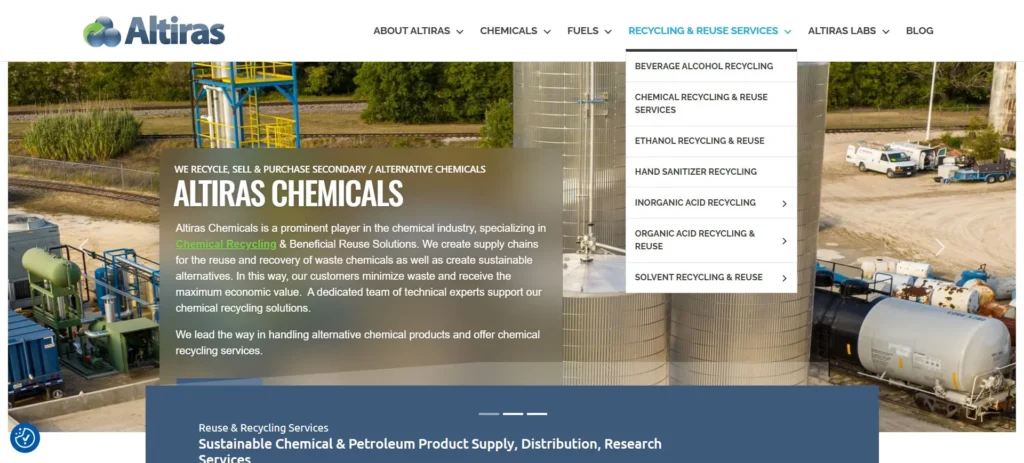
Role: Producer/manufacturer-supplier. Altiras states that it manufactures acetic acid at Cresson, Texas from co-product streams and refines material to glacial acetic acid specifications. This makes it a useful route to investigate for buyers evaluating a U.S. production and refining pathway.
Co-product origin does not make all GAA offers interchangeable. Start with the required grade, permitted impurity profile, intended industrial application, quantity, and destination. Then ask whether the proposed material and documentation fit that requirement. Avoid treating a general production statement as a promise of availability, a particular purity, or a commercial offer for a specific lane.
3. Elchemy: GAA supplier and sourcing partner
Role: Supplier/sourcing partner. Elchemy publishes this article and is not presented as a U.S. glacial acetic acid manufacturer. Its glacial acetic acid product page provides a route to submit a defined industrial requirement for sourcing review and quotation.
Buyer benefits:
- A quote pathway framed around the required specification, volume, destination, packaging preference, and documents.
- A request for current source, lead-time or stock position, regulatory fit, and delivery terms for the individual order.
- Access to glacial acetic acid technical data when technical documentation is needed.
4. Eastman: GAA producer/manufacturer
Role: Producer/manufacturer. Eastman publishes glacial acetic acid product information, including product materials relevant to USP and reagent-grade evaluation. This supports a producer conversation where a buyer needs a documented-grade review rather than a generic commodity comparison.
For regulated, high-purity, or tightly documented requirements, state the exact grade and applicable specification in the RFQ. Confirm the current North American commercial route, the documents that apply to the offered material, and whether the source matches the destination. Do not infer U.S. manufacture for a requested grade solely from a North American product listing without current supplier confirmation.
5. Hawkins: GAA manufacturer-supplier
Role: Manufacturer-supplier. Hawkins describes itself as a supplier, distributor, manufacturer, and blender of food-grade acetic acid on its B2B acetic acid page. Its published positioning makes it worth investigating where grade, concentration, documentation, and food or industrial applicability must be discussed together.
Use the page as a starting point, not as approval evidence for a finished product. Request the exact grade and concentration, current documents, packaging, delivery lane, and confirmation that the offered product fits the intended use. Food-grade language should never be carried across to a different grade or end use without validating the actual supplier documentation and applicable requirements.
6. CORECHEM: bulk GAA supplier/distributor
Role: Supplier/distributor. CORECHEM lists glacial acetic acid and describes itself as a single-location distributor serving primarily the Eastern United States on its acetic-acid product pages. That makes it relevant to buyers assessing bulk acetic acid through a regional distributor rather than assuming a nationwide supply model.
Confirm the current concentration, grade, packaging or bulk-delivery configuration, service geography, document set, and commercial terms before comparing the offer. Regional distribution can be an efficient route when the lane fits, but it is not evidence of availability at every destination. An acetic acid distributor should be assessed against the product and delivery requirements, not its general catalogue alone.
7. GJ Chemical: GAA supplier/distributor
Role: Supplier/distributor. GJ Chemical’s glacial acetic acid announcement describes industrial supply in drums, totes, and tank trucks. This supports its inclusion as a commercial route for buyers comparing package and transport configurations.
Ask which grade, packaging option, delivery lane, and documents apply to the exact request. A supplier’s listed transport formats do not establish a universal service area, manufacturing ownership, or price advantage. The useful comparison is whether the offered package and commercial route match the buyer’s volume, receiving setup, and target delivery date.
8. Univar Solutions: GAA supplier/distributor
Role: Supplier/distributor. Univar Solutions lists glacial acetic acid through its product catalogue, which makes it a practical distribution route to investigate. It belongs in this shortlist as a distributor, not as a GAA manufacturer.
Buyers should ask for the product source, grade, packaging, terminal or warehouse coverage for the delivery location, and current product documents. This is particularly important when comparing multiple acetic acid suppliers, because similar product names may represent different source, pack, freight, and document assumptions. A complete RFQ makes those differences visible before a commercial decision is made.
9. Level 7 Chemical: GAA supplier/distributor
Role: Supplier/distributor. Level 7 Chemical’s GAA product listing and technical-document pathway support its inclusion as a U.S. chemical-distribution route. It may be relevant for a buyer evaluating packaged or industrial GAA supply alongside other supplier options.
Confirm the current grade, packaging, delivery lane, documentation, and commercial terms before treating the listing as a fit. Do not assume manufacturing ownership or a specific grade in stock from a catalogue entry. The buyer should give the supplier a precise specification, purchase cadence, destination, and receiving constraints so that the proposed route can be qualified.
10. INEOS Acetyls in America: GAA producer/manufacturer
Role: Producer/manufacturer. INEOS Acetyls in America identifies acetic acid, including glacial acetic acid grades, and links to sales-specification resources on its U.S. product page. It is a sensible producer route to investigate for a buyer seeking an acetyls-industry conversation around a documented GAA requirement.
Ask which exact grade and sales specification apply, along with the order volume, required documents, and delivery route. A producer label does not establish capacity, regional coverage, price, or lead time for an individual requirement. Those commercial details should be confirmed in writing at RFQ stage.
How to choose a GAA producer or acetic acid distributor
Neither route is automatically better. A producer may sell through direct and indirect channels, while a distributor may add packaging, delivery coordination, or multi-location support. The right decision begins with the buyer’s requirement.
| Decision factor | Producer/manufacturer route may suit | Supplier/distributor route may suit | Buyer input |
|---|---|---|---|
| Product requirement | Defined grade, specification, and recurring demand | Need help matching a documented offer to the requirement | Grade, impurities, required documents |
| Order pattern | Regular or larger-volume commercial discussion | Variable volumes or packaged needs | Quantity, cadence, destination |
| Logistics | Established delivery and receiving route | Packaging or delivery model needs review | Receiving constraints, ship-to ZIP |
| Quality review | Direct product-specification discussion | Source and documents must be matched to the need | Current specification, SDS, CoA requirement |
Choose a producer route when the grade, volume, and lane are already clear and a direct commercial discussion is practical. Choose a supplier or distributor route when sourcing coordination, packaging options, or delivery qualification are central to the purchase. In either case, the offer should be approved on the current document set, not on a label alone.
What to include in a glacial acetic acid RFQ
A complete RFQ helps suppliers assess whether the material and commercial route fit. Include:
- Required product: Grade, concentration, and permitted impurity profile.
- Use context: The intended industrial application at a high level. For food-production context, see Acetic acid uses in food production, but do not substitute a use article for grade qualification.
- Demand: Quantity, buying cadence, target delivery date, and whether the requirement is spot or recurring.
- Destination: Ship-to location, receiving constraints, and preferred packaging or transport configuration where known.
- Documents: Current product specification, SDS, CoA where required, and customer compliance requirements.
- Written confirmation: Commercial availability and transport fit for the stated route.
This is a procurement checklist, not a procedure for using the chemical. Glacial acetic acid requires current supplier documentation and the buyer’s EHS and site procedures. Review the Glacial acetic acid safety data sheet and consult qualified supplier and EHS contacts for the actual material and site.
Bulk acetic acid quote factors
Price comparison is meaningful only when the offers match on product and route. Grade, concentration, impurity limits, documentation, volume, purchasing cadence, package, delivery configuration, destination, and receiving constraints can all change a GAA quote. Current feedstock and supply conditions can also affect commercial terms.
Do not compare price ranges unless quotations use the same specification, volume, pack, delivery geography, and terms. A lower unit number can exclude freight, documentation, or delivery assumptions that appear elsewhere in the quote. Ask every supplier to state what is included and what remains subject to confirmation.
How Elchemy can support GAA sourcing
Elchemy is included here as a supplier/sourcing partner and article publisher, not as a U.S. manufacturer. Its role is to help industrial buyers turn a broad supplier search into a qualified commercial request. Provide the specification, high-level application, volume, destination, packaging preference where known, and document requirements through the GAA specifications and quote pathway.
That information supports a review of potential product fit, documentation, and commercial delivery options. It does not replace the buyer’s technical, EHS, regulatory, or supplier-qualification process. Before approval, obtain the current specification, SDS, CoA where applicable, product-source information, commercial terms, and written confirmation that the proposed route fits the destination. For a wider due-diligence framework, use these chemical supplier checkpoints.
FAQs
Who manufactures glacial acetic acid in the USA?
The producer or manufacturer routes in this shortlist are Celanese, Altiras Chemicals, Eastman, Hawkins, and INEOS Acetyls in America. The labels describe published commercial roles, not a capacity or quality ranking. Confirm the requested grade, documents, and delivery route before selecting a supplier.
What does glacial acetic acid mean?
Glacial acetic acid is concentrated acetic acid, generally 99.5% or more, named for its tendency to form ice-like crystals near room temperature. That term does not establish the required grade, impurity profile, regulated-use suitability, documentation, package, origin or delivery route. Buy against the approved written specification.
Are glacial acetic acid suppliers and manufacturers the same?
No. A manufacturer produces the material. A supplier or distributor may source, package, coordinate, and deliver it. Some companies perform multiple roles, which is why the role labels should be checked before an RFQ is sent.
Which GAA package should I request?
Ask for the package and delivery configuration that match the required quantity, receiving equipment and delivery lane. Drums, totes and bulk formats are common commercial options, but a listed format does not establish availability for a specific grade, destination or order size. Confirm the actual package, net quantity and transport fit in writing.
What should a bulk glacial acetic acid RFQ include?
Include the grade, concentration, permitted impurity profile, volume, cadence, destination, packaging preference, and required documents. Also ask for written confirmation of commercial availability and transport fit. This makes bulk acetic acid quotations easier to compare on a like-for-like basis.
Is glacial acetic acid suitable for food or pharmaceutical use?
Suitability depends on the documented grade and applicable requirements. The word “glacial” does not establish food, pharmaceutical, or any other regulated-use suitability. Verify the exact product specification and supporting documents for the intended use.
Can Elchemy source glacial acetic acid in the USA?
Elchemy provides a sourcing and quote pathway for a defined industrial GAA requirement. Submit the specification, volume, destination, packaging needs, and document requirements through the glacial acetic acid product page. Availability and commercial fit are confirmed case by case.
Conclusion
The most useful way to compare glacial acetic acid manufacturers is to start with grade and documentation, then qualify volume and delivery route, and finally decide whether a producer or distributor conversation fits the requirement. This Top 10 is a role-verified starting shortlist, not a quality, capacity, or price ranking.
When the requirement is defined, Request a Quote with the specification, volume, destination, and required documents to begin a documented sourcing review.