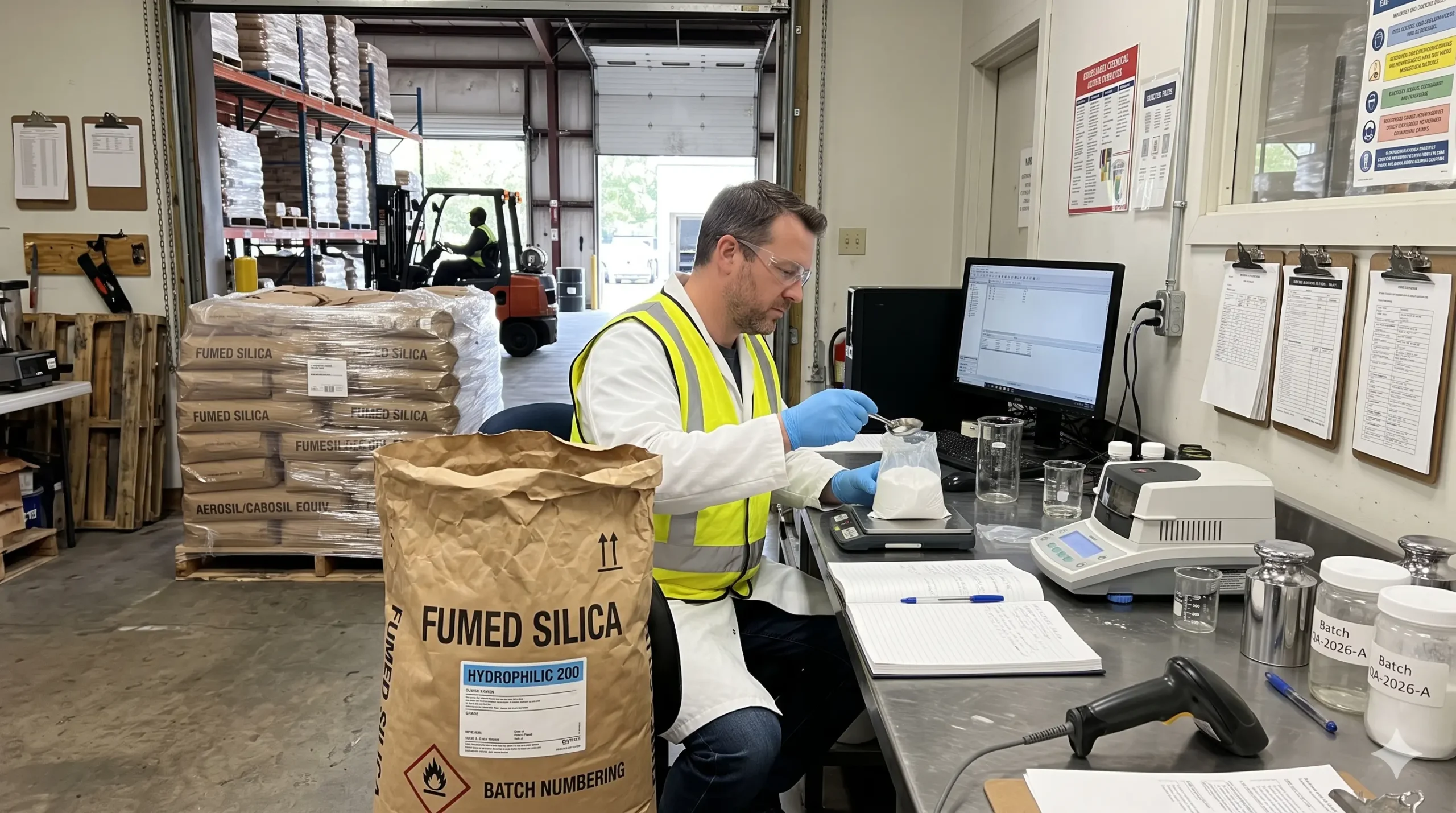


At a Glance
- Start with the application: Specify the formulation and required performance before choosing a grade.
- Compare treatments carefully: Hydrophilic and hydrophobic describe different surface characteristics. Neither is a universal winner.
- Check the exact grade: Similar brand names or surface-area values do not establish equivalence.
- Qualify the offer: Confirm product identity, documents, packaging, MOQ, origin, and delivery terms.
- Compare like with like: Ask each supplier to quote the same specification, quantity, destination, and delivery basis.
What you’ll learn
Learn how to compare fumed silica grades and supplier offers, what to verify in proposed Cab-O-Sil® or AEROSIL® alternatives, and what information to include in a bulk RFQ.
Introduction
A fumed silica quote is useful only if it describes a grade that fits your application. A familiar brand name or a “hydrophobic” label does not prove that the product will perform as required or match another grade.
This guide is for US procurement teams, formulators, and technical buyers comparing suppliers or preparing a purchase. It covers grade selection, technical documents, and commercial terms. Elchemy lists fumed silica and a pricing request on its fumed silica product page; confirm the grade, availability, and quote terms for your specific order.
What is fumed silica, and how is it different from other silica?
Fumed silica is synthetic amorphous silicon dioxide, also called pyrogenic silica. It is made through a vapor-phase process, while precipitated silica is produced through a wet process. These materials should not be treated as interchangeable just because both are forms of silica. FAO’s silicon dioxide monograph describes the distinction between these production routes.
For purchasing, first confirm the product identity and process route in the supplier documentation. Then check that the grade and its specifications match your application. “Silica” by itself is too broad a description for a reliable comparison.
Fumed silica can serve functions such as thickening, rheology control, anti-settling, and powder flow assistance. Suitability depends on the grade and formulation. For broader context, see <u>industrial silica uses</u>.
Hydrophilic vs. hydrophobic fumed silica: which should you choose?
Choose a candidate based on its documented surface characteristics and fit with your formulation. Hydrophilic fumed silica is generally untreated; hydrophobic grades have a modified surface. Treatment chemistry and degree vary by grade, so the labels alone do not establish suitability.
Surface treatment can affect water interaction and rheological behavior. For example, one study of fumed silica in polyurethane adhesives found that the measured properties depended on the particular materials and formulation being tested. Treat that result as formulation-specific, not a general rule for other applications.
| Buyer comparison point | Hydrophilic candidate | Hydrophobic candidate | What to verify |
| Surface | Generally untreated, with surface silanol groups | Surface modified; treatment chemistry varies by grade | Exact treatment and grade |
| Water interaction | May adsorb more water than a treated grade | Treatment may reduce water adsorption; degree varies | Grade-specific data and storage conditions |
| Formulation fit | Must be evaluated in the intended system | Must be evaluated in the intended system | Application, process, and target performance |
| Performance evidence | Supplier data and formulation testing | Supplier data and formulation testing | Test conditions and formulation match |
Practical decision: Select by grade-specific documentation and application performance. If the supplier cannot identify the grade or provide supporting technical information, treat the offer as unqualified until that gap is resolved.
Are Cab-O-Sil® and AEROSIL® equivalents?
Not automatically. Compare the exact grades and their published data; a shared application or similar surface-area value does not establish a one-to-one equivalent. The table below gives examples from public product documents to illustrate the comparison. Manufacturer-reported typical values are not product specifications, and the examples do not establish availability through Elchemy.
| Grade example | Surface type / treatment | Published BET surface area | Other published data | Buyer interpretation |
| CAB-O-SIL® M-5 | Hydrophilic; untreated | Nominally 200 m²/g | Cabot describes it as medium-surface-area fumed silica | Candidate to compare with hydrophilic grades near this range |
| AEROSIL® 200 | Hydrophilic | 175–225 m²/g | pH 3.7–4.5 in 4% dispersion; loss on drying ≤1.5% | Published range overlaps the nominal M-5 value; this alone does not prove equivalence |
| CAB-O-SIL® TS-610 | Hydrophobic; dimethyldichlorosilane treatment | Nominally 130 m²/g base silica | Cabot describes the value as typical, not a product specification | Compare treatment, application data, and current supplier specifications |
| AEROSIL® R 972 | Hydrophobic | 90–130 m²/g | Loss on drying ≤0.5%; pH 3.6–5.5; carbon content 0.6–1.2% | Surface-area range overlaps the nominal TS-610 value, but equivalence still requires evaluation |
| ELVISC™–FuSi, Elchemy listing | Surface treatment not stated on the public listing | Not stated on the public listing | Listing identifies fumed silica, CAS 112945-52-5, and SiO₂ | Request the current TDS to confirm grade-specific details |
The M-5 and TS-610 figures are from Cabot’s product information and selector guide. Evonik reports the AEROSIL® values as typical in its AEROSIL® 200 product information and hydrophobic grade overview. Request the current sales specification for the actual offered product.
Ask the supplier to identify the precise alternative grade, provide its current TDS, and explain how it compares against your requirements. Your technical team should decide whether testing or internal approval is needed before changing a qualified formulation.
Which applications can affect fumed silica pricing?
The application can affect which grade is quoted, so disclose it when requesting pricing. A quote for one grade should not be compared with a different grade on price alone if their specifications or intended uses differ.
Describe the required function, formulation, and any buyer-defined specification limits. If the grade is still under evaluation, tell suppliers what the material must do and request technical data, but do not treat a proposed grade as approved without qualification.
For application-specific context, see <u>Cabosil / thickening applications</u> [Fumed Silica as Thickening & Thixotropic Agent: Applications in Coatings, Adhesives & Composites].
| Pricing factor | What to provide or confirm | Why it affects comparison |
| Grade and specification | Exact grade, treatment, and required limits | Different grades may not be technically comparable |
| Quantity and frequency | Order quantity and expected repeat frequency | Supplier quote basis may vary by volume |
| Packaging and MOQ | Requested pack format and minimum order | Affects handling, storage, and order size |
| Destination and delivery basis | Ship-to ZIP code and requested delivery terms | Freight and included services vary |
| Documentation | TDS, SDS, COA, or buyer-specific requirements | Additional quality requirements may affect offer scope |
| Timing | Required arrival date and quote validity | Availability and validity are offer-specific |
How do you qualify a fumed silica supplier?
A qualified offer should identify the product and grade and make its commercial basis clear. Confirm whether you are dealing with a manufacturer, distributor, or sourcing partner, and ask who is responsible for documentation and technical support.
Use this checklist for each offer:
- Confirm the full grade name and product identity.
- Request the current TDS and compare it with your requirements.
- Ask whether an SDS and shipment-specific COA are available.
- Confirm lot or batch traceability requirements.
- Verify packaging, MOQ, country of origin, availability, and lead time.
- Check quote validity, payment terms, freight, and delivery basis.
- Ask how proposed substitutions or source changes will be communicated.
A supplier that cannot identify the grade or clarify the quote basis has not provided enough information for a meaningful comparison. Review the SDS for product-specific handling requirements. Elchemy’s North American chemical sourcing network provides regional supplier context. For broader sourcing context, see specialty chemical suppliers in North America.
How should buyers compare fumed silica quotes?
Compare technically acceptable offers on the same quantity, packaging, delivery, and documentation basis. A lower unit price may not mean a lower delivered cost, and it does not establish that the offered grade meets your specification.
| Quote field | Record for each supplier | Comparison check |
| Grade and specification | Full grade name and quoted specification | Same grade or technically approved alternative |
| Quantity and unit | Offered amount and unit of measure | Same quantity basis |
| Packaging and MOQ | Pack type and minimum order | Comparable pack and order size |
| Unit price | Price, currency, and unit | Same currency and unit |
| Freight and delivery | Included costs and delivery basis | Confirm what is included |
| Lead time and validity | Quoted timing and offer expiry | Meets purchasing schedule |
| Documentation | Documents included or available | Meets buyer quality requirements |
| Technical acceptance | Approved, pending, or rejected | Do not compare unapproved alternatives as equivalent |
To request product-specific pricing, buy fumed silica in bulk through Elchemy’s product page. Confirm the grade and terms offered for your order.
What should a bulk fumed silica RFQ include?
A useful RFQ gives every supplier the same technical and delivery requirements. This reduces the chance of comparing offers for different grades, quantities, or shipment terms as if they were identical.
Include the application and formulation system, required function, preferred grade or specification, quantity, packaging preference, ship-to location, required documents, and requested delivery basis. Add target timing and quote validity needs if they are known.
If you will consider substitutes, ask suppliers to identify each proposed grade and explain how it meets your requirements. Keep the original specification visible so an alternative does not silently become the assumed basis for the quote.
What is the final supplier decision test?
Proceed only when the technical and commercial offer is clear enough for your organization to approve. Use the same standard for each candidate and record what remains unresolved.
| Decision status | Next action |
| Grade documents match the requirements | Move to internal approval |
| Alternative grade is proposed | Compare specifications and complete required evaluation |
| Quote basis is incomplete | Request a revised, itemized offer |
| Availability, origin, or lead time is unclear | Confirm before committing to purchase |
| Required documents are unavailable or unconfirmed | Hold qualification until resolved |
Frequently asked questions
1. Is fumed silica the same as precipitated silica?
No. Both are forms of synthetic amorphous silicon dioxide, but they are produced by different processes. Fumed, or pyrogenic, silica is made through a vapor-phase route, while precipitated silica is made through a wet process. Confirm the material identity and grade in supplier documentation before comparing offers.
2. What is the difference between hydrophilic and hydrophobic fumed silica?
The terms describe differences in surface characteristics, including whether the surface has been modified. That can affect how a grade interacts with a formulation, but the label alone does not establish suitability. Compare the actual grade data and evaluate candidates in the intended system.
3. Are Cab-O-Sil® and AEROSIL® interchangeable?
Not automatically. They are product families, and an alternative should be assessed against the exact grade in use. Compare supplier documentation and buyer-required specifications, then complete any internal testing or approval required before changing a qualified formulation or purchase specification.
4. What documents should I request from a supplier?
Ask which technical and quality documents are available for the specific product and shipment. Common requests include a current TDS, SDS, and COA, along with lot or batch traceability information. Your quality requirements may call for additional documents, so state them in the RFQ.
5. What information do suppliers need to quote bulk fumed silica?
Provide the application, required grade or specification, quantity, packaging preference, ship-to location, required documents, and requested delivery basis. If you will consider alternatives, ask suppliers to name each proposed grade and document how it meets your requirements.
6. Should I choose the lowest-priced fumed silica quote?
Not until the offers are comparable and the grade is technically acceptable. Check that each quote covers the same specification, quantity, packaging, delivery basis, and documentation. Record missing freight or other costs as unresolved rather than assuming they are included in the unit price.
Conclusion
A reliable fumed silica purchase starts with a clear application and specification. Compare documented grades, confirm supplier responsibilities, and evaluate quotes on a consistent delivered-cost basis. Treat brand alternatives as candidates until technical review and any required testing are complete.
Elchemy lists fumed silica and a pricing request on its product page. For product-specific details, buy fumed silica in bulk and confirm the grade, availability, documentation, and commercial terms for your requirements.