

At a Glance
- Start with the exact material requirement: Soda ash is sodium carbonate, but a quote is only comparable when the buyer also defines the required form, specification, quantity, and delivery location.
- Dense versus light is a procurement decision: Select the form that fits the operating process and site-handling requirements, then confirm the supplier’s technical data before approval.
- Documentation is part of product qualification: Review the TDS, SDS, and required batch-quality documentation before placing an order.
- Compare quotes on the same basis: Quantity, packaging, destination, commercial terms, and required documents should be consistent across all supplier requests.
- A complete RFQ shortens the buying cycle: A supplier can respond more accurately when the intended application, delivery requirement, and technical expectations are clear.
What you’ll learn
This guide explains how industrial buyers can define a soda ash requirement, evaluate supplier documentation, compare supply routes, and prepare a quote-ready RFQ.
Introduction
Buying soda ash for industrial use involves more than finding a seller. Procurement teams need to specify the required form, align the material with their internal operating requirements, review technical and safety documents, and make sure every supplier is quoting against the same commercial brief. Without that structure, quotations are difficult to compare and the risk of approving an unsuitable material rises.
This guide is for B2B buyers sourcing soda ash, also known as sodium carbonate, for industrial applications. It provides a practical framework for moving from an initial requirement to a qualified supplier conversation, without relying on retail listings, unverified price comparisons, or generic supplier claims.
Where to Buy Soda Ash for Industrial Use
Industrial buyers can source soda ash through a producer, a distributor, or a chemical sourcing partner. The right route depends on the buyer’s order profile, qualification process, documentation needs, and ability to manage logistics directly. There is no universal best option.
Soda ash is the trade name for sodium carbonate. USGS notes that it may be produced from natural sources such as trona or sodium-carbonate-bearing brines, or through synthetic chemical processes. For procurement teams, the practical point is to confirm the required product specification and supply documentation rather than assume that every material marketed as soda ash is interchangeable. USGS Soda Ash Statistics and Information
Before searching for a soda ash supplier, establish the buying requirement internally. A supplier should be able to quote against a clearly defined request, not a vague instruction to provide “bulk soda ash.”
| Requirement | What the buyer should confirm |
| Material identity | State soda ash or sodium carbonate and include the internal material code where applicable |
| Product form | Specify whether dense or light soda ash is required |
| Intended application | Describe the process or formulation where the material will be used |
| Technical requirement | Provide the internal specification and required test parameters |
| Quantity | State the one-time requirement, monthly demand, or annual forecast |
| Delivery location | Provide the facility address, receiving hours, unloading constraints, and storage limitations |
| Required documents | State whether TDS, SDS, COA, or application-specific documents are required |
| Commercial terms | State the target delivery date, payment expectations, and quotation basis |
Choose Dense or Light Soda Ash Before Requesting Quotes
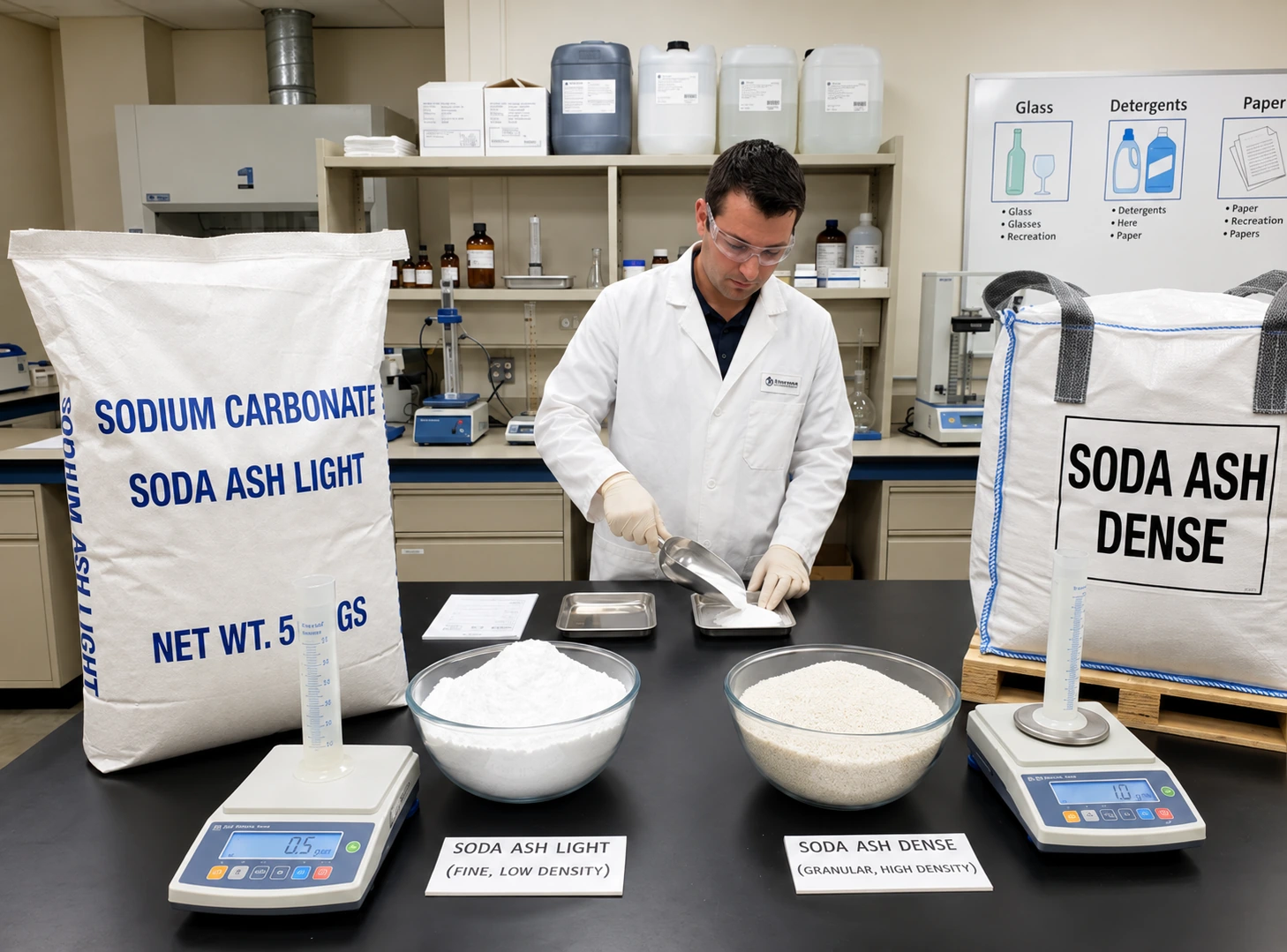
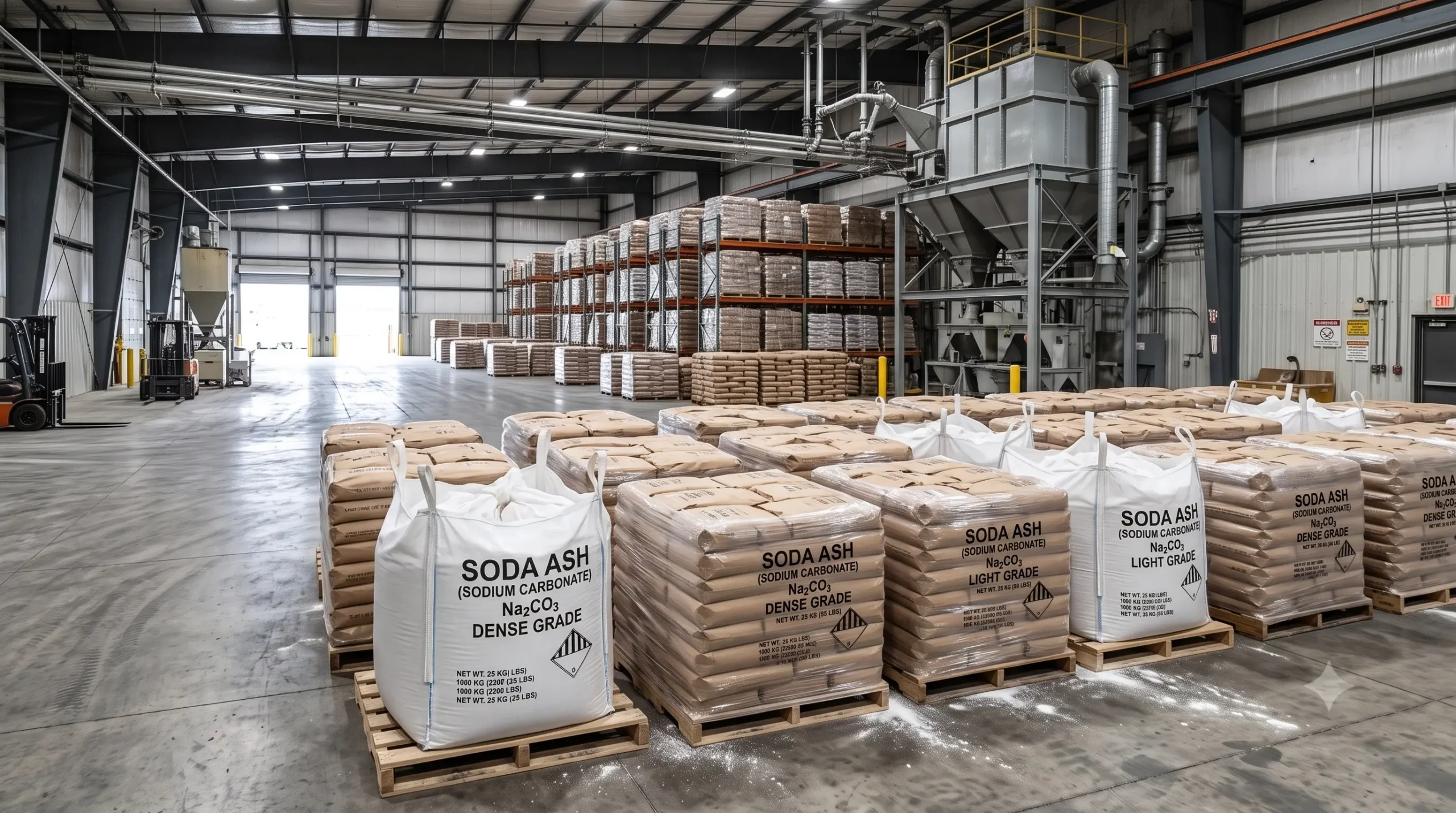
Soda ash is commonly offered in dense and light forms. Buyers should not treat this distinction as a minor product-description detail because the selected form needs to match the process, handling method, and internal specification.
The right choice should come from the technical or operations team that owns the application. Procurement can then use that requirement to ask suppliers for the relevant product documentation and avoid comparing quotations for different forms as though they were identical.
| Decision factor | Dense soda ash | Light soda ash | Buyer action |
| Process requirement | Confirm suitability with the process owner | Confirm suitability with the process owner | Record the approved form in the RFQ |
| Handling and storage | Validate against site conditions | Validate against site conditions | Review receiving and storage constraints |
| Technical documentation | Request supplier TDS | Request supplier TDS | Compare documentation against the internal specification |
| Supplier quotation | Confirm the dense form is stated clearly | Confirm the light form is stated clearly | Reject quotations that do not identify the form |
The current Elchemy Soda Ash product page presents both dense and light forms and provides access to technical and safety documentation. Buyers should still confirm that the product being quoted matches their application-specific requirement before approving a purchase.
If the technical team has not specified a form, pause the sourcing process long enough to obtain that input. Choosing on price alone can create unnecessary requalification work later.
Select the Right Soda Ash Supply Route
Buying directly from a manufacturer may suit organizations with established demand, a defined qualification process, and the ability to manage larger commercial commitments. A distributor may be a better fit where the buyer needs product aggregation, local coordination, or a more flexible ordering structure.
A sourcing partner can be useful when a buyer needs support aligning supplier documentation, commercial requirements, and delivery expectations. The appropriate route depends on the buyer’s needs, not on a blanket claim that one supply model is superior.
| Supply route | Often suitable when | Buyer questions to ask |
| Direct manufacturer | Demand is established and requirements are highly defined | Can we meet the supplier’s commercial and ordering requirements? |
| Distributor | The buyer needs regional coordination or supply flexibility | Can the distributor provide the required technical and quality documentation? |
| Sourcing partner | The buyer needs procurement support across qualification and commercial stages | What supplier evidence, documentation, and delivery coordination are included? |
Buyers who are still mapping the supplier landscape can review Soda Ash Manufacturers and Suppliers in the USA. Use that resource to understand the market, then return to a consistent evaluation framework before choosing a supplier.
Choose a direct manufacturer route if the business can support its purchasing conditions and has a fully defined requirement. Choose a distributor or sourcing partner if documentation coordination, commercial flexibility, or delivery support is a more immediate priority. In every case, assess the quoted product against the same specification and documentation checklist.
Verify Technical, Safety, and Quality Documentation
Technical documentation is not an administrative afterthought. It is the evidence a procurement and quality team uses to confirm that the supplier has quoted the intended product and that the material can enter the internal qualification process.
At minimum, identify which documents are required before asking for a quote. The exact documentation package will vary by application and internal controls, so buyers should avoid assuming that an SDS alone is sufficient.
| Document | Procurement purpose |
| Technical Data Sheet, or TDS | Reviews product characteristics against the internal specification |
| Safety Data Sheet, or SDS | Supports workplace safety and handling review |
| Certificate of Analysis, or COA | Provides batch-specific quality information when required |
| Application-specific documents | Supports internal quality, regulatory, or customer requirements where applicable |
The supplier should be able to clarify which documents are available with the quoted product. The buyer should then verify document format, revision status, and internal acceptance criteria before issuing a purchase order.
For a broader supplier-evaluation framework, readers can compare industrial chemical supplier qualification criteria [Where to Buy Acid: How to Choose an Industrial Chemical Supplier]. The same discipline applies here: define the requirement first, then assess evidence against that requirement.
Confirm Packaging, Delivery, and Receiving Requirements
A technically suitable soda ash quotation can still fail operationally if the delivery format does not fit the receiving site. Procurement should involve warehouse, logistics, and plant stakeholders before finalizing the order.
Confirm the delivery location, available receiving equipment, unloading constraints, storage capacity, appointment requirements, and inspection process. These details should be part of the RFQ rather than discovered after the supplier has prepared a quotation.
For example, an industrial buyer may have an approved product specification but limited storage space or a receiving schedule that affects order frequency. That does not make the product unsuitable. It means the quotation and delivery plan need to reflect the actual operating environment.
Soda ash may support different industrial sectors, so application context matters. Buyers evaluating use cases connected to water treatment and mining or home care and industrial cleaning should confirm their own process and documentation requirements rather than rely on a general application statement.
Use a Supplier Scorecard Before Making a Decision
A supplier scorecard prevents teams from choosing based on one visible factor, such as initial quoted price, while overlooking technical or operational fit. It also helps multiple stakeholders evaluate suppliers consistently.
Use the same scoring questions for every shortlisted supplier. If a supplier cannot provide an answer or the required evidence, record that as a qualification gap rather than filling it with an assumption.
| Evaluation criterion | Questions to ask |
| Product fit | Does the quotation clearly state the correct soda ash form and match the internal specification? |
| Documentation | Are the required TDS, SDS, COA, and other documents available for review? |
| Commercial fit | Is the quote based on the same quantity, delivery point, and commercial terms as competing quotes? |
| Delivery fit | Can the proposed delivery arrangement meet receiving and storage requirements? |
| Qualification support | Can the supplier provide the evidence needed by procurement, quality, and operations teams? |
| Communication quality | Are technical and commercial questions answered clearly and consistently? |
A practical approach is to set minimum acceptance criteria before reviewing prices. For instance, a quotation that lacks the required product form or documentation should not move forward simply because its commercial terms appear attractive.
Build a Quote-Ready Soda Ash RFQ
A strong RFQ makes it easier for suppliers to respond accurately and for buyers to compare replies fairly. It also reduces follow-up questions that can slow down approval.
Before sending an RFQ, gather the following information from internal stakeholders:
- State “soda ash” or “sodium carbonate” and identify the required dense or light form.
- Describe the intended industrial application without disclosing unnecessary proprietary information.
- Attach or reference the internal product specification where appropriate.
- Specify quantity, purchase frequency, and desired delivery timing.
- Provide the delivery location and any receiving or unloading limitations.
- List required documents, including TDS, SDS, COA, or application-specific requirements.
- Request that commercial terms and quote validity are stated clearly.
A concise RFQ can use this format:
| RFQ field | Information to provide |
| Material | State soda ash or sodium carbonate |
| Required form | Specify dense or light soda ash |
| Application | Describe the intended industrial process or formulation |
| Required specification | Attach or reference the approved internal specification |
| Quantity and frequency | State volume, unit of measure, and purchase frequency |
| Delivery location | Provide the facility address, receiving hours, and unloading restrictions |
| Documentation required | List TDS, SDS, COA, and any additional requirements |
| Required delivery date | State the target delivery date or supply schedule |
| Commercial requirements | State payment expectations, quotation currency, and quote validity needs |
Buyers who need more technical context before completing the RFQ can understand sodium carbonate properties and grades [What Is Sodium Carbonate? Properties, Uses and Grades].
Common Soda Ash Buying Mistakes
The most common mistake is requesting quotations without defining dense or light soda ash. That leaves suppliers to interpret the requirement, and it can result in replies that cannot be compared fairly.
Another frequent issue is comparing price lines that are based on different quantities, packaging arrangements, delivery assumptions, or documentation commitments. A lower figure does not represent a lower total procurement risk if the scope of supply differs.
Finally, do not treat an SDS as a substitute for a TDS or a required COA. Each document serves a different function in supplier and product qualification.
FAQs
1. Is soda ash the same as sodium carbonate?
Yes. Soda ash is the industrial trade name for sodium carbonate. Buyers should still state the required form and specification in the RFQ because the material name alone does not define the full purchasing requirement.
2. How do I choose between dense and light soda ash?
Choose the form specified by the process owner or technical team. The procurement team should then request product documentation and confirm that the quoted form matches the approved internal requirement.
3. What documents should I request from a soda ash supplier?
Request the documents required by your internal qualification process, commonly including a TDS, SDS, and, where needed, a COA. Any application-specific quality or regulatory documentation should be defined before the supplier quote is approved.
4. Should I buy soda ash directly from a manufacturer or through a distributor?
It depends on your purchasing profile and support requirements. Direct purchasing may suit established demand and defined commercial capability, while a distributor or sourcing partner may better support documentation coordination, flexible procurement, or delivery planning.
5. What should be included in a soda ash RFQ?
Include the required dense or light form, intended application, technical specification, quantity, delivery location, required delivery date, and documentation requirements. Providing this information upfront helps suppliers prepare quotations that can be compared on the same basis.
6. How should I compare soda ash supplier quotes?
Compare quotations using consistent criteria, including product form, specification, documents, quantity, delivery point, commercial terms, and receiving requirements. Do not compare price alone when suppliers are quoting different scopes of supply.
Source Soda Ash With a Clear Procurement Framework
Choosing a soda ash supplier is not simply a price decision. The strongest purchasing outcome comes from defining the required form, validating the product documentation, confirming delivery requirements, and comparing equivalent quotations on the same commercial basis. This approach gives procurement, quality, and operations teams a shared way to qualify a supplier before an order is placed.
That preparation helps reduce avoidable clarification, creates a more consistent approval record, and keeps commercial discussions focused on requirements that matter. Once your team has confirmed its dense or light requirement, specification, quantity, location, and documentation needs, move to a product-specific conversation. Request a Soda Ash quote from Elchemy.