

At a Glance:
- Quaternary ammonium compounds work at 200–400 ppm with 30-second contact time on food surfaces
- Peracetic acid needs just 60–80 ppm and kills bacteria in under 30 seconds with no rinse needed
- Chlorine bleach solutions at 50–200 ppm are cheap but leave residue requiring water rinse
- Hydrogen peroxide at 0.5–3% concentration breaks down to water and oxygen after use
- Contact time matters more than concentration — rushing sanitization defeats the purpose
- FDA and USDA approve specific compounds for direct food contact at defined concentrations
- Surface material affects disinfectant choice — stainless steel needs different treatment than plastic
- Temperature impacts effectiveness — cold surfaces slow down most disinfectants by 30-50%
A juice bottling facility in California failed an inspection. The inspector found Listeria on their filling equipment even though workers cleaned and sanitized everything daily. After investigation, the problem was simple: they were using quaternary ammonium sanitizer on equipment still wet from rinsing. The water diluted the sanitizer below effective levels. Once they started letting surfaces drain properly before applying sanitizer, the bacteria counts dropped to zero.
Right product. Wrong application. The difference was in following the actual procedure.
Choosing the right food disinfectant means understanding more than just chemical names. You need to know what concentration kills which pathogens, how long surfaces need to stay wet, whether you need to rinse afterward, and what materials react badly with your chosen product. Food processing facilities can’t just spray something and hope it works — regulations demand documented proof that your sanitization actually kills harmful bacteria.
What Makes a Food Disinfectant Different
Regular disinfectants you’d use in hospitals or homes aren’t safe around food. They leave residues that can contaminate products or cause health problems if people eat them. Food-grade disinfectants need FDA or USDA approval showing they’re safe for surfaces that touch food.
These approved products either break down into harmless substances or can be used at such low concentrations that any residue won’t hurt anyone. You’ll see them listed as D2 sanitizers (no rinse required) or D1 sanitizers (rinse required after use).
Key Requirements
A disinfectant for food industry use must meet several standards. It needs to kill specific bacteria within a set contact time. It must work at temperatures you’ll actually use in production — usually between 24–49°C. The chemical can’t react with or damage food contact surfaces like stainless steel, plastic conveyor belts, or rubber gaskets.
Smell matters too. Strong odors can transfer to food products, so most food-grade sanitizers are either odorless or have very mild scents that dissipate quickly.
Must-have properties:
- EPA registration for food contact surface use
- Documented kill rates against specific pathogens (E. coli, Salmonella, Listeria)
- Defined use concentrations and contact times
- Compatibility with stainless steel, food-grade plastics, and rubber
- Low or no residue that could affect food taste or safety
- Stability during storage in concentrate and diluted forms
| Agency/Standard | Requirement | Testing Method |
| EPA (US) | Registration under FIFRA | AOAC efficacy testing |
| FDA | GRAS status or food additive approval | 21 CFR compliance |
| USDA | Approved for meat/poultry facilities | FSIS guidelines |
| NSF International | Category D1 or D2 listing | NSF/ANSI Standard 51 |
| Contact time | 30 sec to 10 min depending on product | Surface inoculation test |
Quaternary Ammonium Compounds (Quats)
How They Work
Quaternary ammonium compounds — usually just called quats — work by disrupting bacterial cell membranes. The positive charge on the quat molecule attracts to the negative charge on bacteria surfaces. This damages the cell wall and the bacteria dies.
Quats are popular because they’re stable, don’t have strong odors, and work well in hard water. They don’t corrode most surfaces. You can apply them without rinsing if you use the right concentration.
Common Types
You’ll see several quat types in food facilities. Benzalkonium chloride is the most common. Didecyl dimethyl ammonium chloride shows up in dual-quat formulations that work better against some bacteria. Each type has slightly different strengths against various microorganisms.
Quat applications:
- Food contact surfaces: 200–400 ppm concentration with 30-second contact
- Floor drains and non-food areas: 400–800 ppm for tougher biofilms
- Conveyor belts: spray or foam application at 200 ppm minimum
- Storage areas: fogging at 400 ppm for air and surface treatment
- Equipment parts: immersion tanks at 200 ppm, 1-minute dwell time
Limitations
Quats lose effectiveness in the presence of organic matter. If you’re sanitizing a surface that still has food residue or protein buildup, the quat binds to that material instead of the bacteria. This is why you always clean first, then sanitize.
Some materials absorb quats. Soft plastics and rubber can soak them up, then release them slowly over time. This affects both the sanitization process and potentially the food that touches those surfaces later.
They don’t work well against certain bacteria. Pseudomonas and some spore-forming bacteria show resistance to quats. If your facility has these problems, you need a different sanitizer or a rotation program.
| Quat Type | Concentration | Contact Time | Best Use |
| Benzalkonium chloride | 200–400 ppm | 30 seconds | General surfaces |
| Didecyl dimethyl ammonium | 200–400 ppm | 30–60 seconds | Gram-positive bacteria |
| Dual-quat blends | 200–400 ppm | 30 seconds | Broad spectrum |
| Quat + alcohol | 200 ppm + 70% alcohol | 15 seconds | Quick spray sanitizing |
Peracetic Acid (PAA) — No-Rinse Performance
Chemistry and Action
Peracetic acid is a mix of acetic acid (vinegar) and hydrogen peroxide. It’s a powerful oxidizer that destroys bacteria, viruses, fungi, and spores by oxidizing their cell structures. Unlike chlorine, it works well in cold water and doesn’t lose effectiveness in the presence of organic matter.
The big advantage is that peracetic acid breaks down into acetic acid, water, and oxygen — all harmless. This means no toxic residue and often no rinsing needed.
Concentration and Usage
Food processing facilities use peracetic acid at 60–80 ppm for most applications. At these levels, contact time is usually 30 seconds or less. For tougher biofilms or spore-forming bacteria, you might go up to 200 ppm.
Temperature doesn’t affect PAA as much as other sanitizers. It works fine in cold rooms and refrigerated processing areas where other chemicals slow down significantly.
PAA applications in food plants:
- CIP (clean-in-place) systems: 80–150 ppm circulated through pipes and tanks
- Spray washing produce: 40–80 ppm with 15–30 second exposure
- Equipment sanitization: 80 ppm spray or foam, no rinse needed
- Poultry and meat processing: 200–400 ppm for carcass washing
- Brewery tank sanitization: 100–200 ppm, 1–2 minute contact
- Cold storage areas: 60–80 ppm fogging for walls and ceilings
Safety and Handling
Peracetic acid has a strong vinegar smell that some workers find unpleasant. Good ventilation helps. The concentrated product (usually 15–25% PAA) is corrosive and requires careful handling with proper PPE.
You can’t store diluted PAA solutions for long periods. The compound slowly breaks down, losing effectiveness over days or weeks depending on storage conditions. Most facilities mix it fresh daily or use automated dilution systems.
| Property | Peracetic Acid | Chlorine | Quats |
| Working concentration | 60–200 ppm | 50–200 ppm | 200–400 ppm |
| Contact time | 15–30 seconds | 30–60 seconds | 30–60 seconds |
| Rinse required | Usually no | Yes (food surfaces) | Usually no |
| Works in cold water | Yes | Slower | Slower |
| Organic matter tolerance | Good | Poor | Poor |
| Residue breakdown | Water + oxygen | Chloride salts | Absorbed by materials |
| Cost per use | Medium-high | Low | Low-medium |
Chlorine-Based Sanitizers
Sodium Hypochlorite (Bleach)
Chlorine bleach is probably the most widely used food disinfectant because it’s cheap, effective, and easy to get. At 50–200 ppm available chlorine, it kills most bacteria in 30–60 seconds. Food facilities use it for everything from floor cleaning to sanitizing small equipment.
The catch is you need to rinse after using chlorine on food contact surfaces. Chlorine residue can react with organic compounds in food creating off-flavors or potentially harmful byproducts. It also corrodes stainless steel and aluminum if you’re not careful with concentration and contact time.
Chlorine Dioxide
Chlorine dioxide is different from regular bleach chemistry. It’s a true gas dissolved in water, which makes it more stable and effective at a wider pH range. You can use lower concentrations — typically 5–20 ppm — and still get good bacteria kill.
Food processing facilities use chlorine dioxide for washing fruits and vegetables, sanitizing processing equipment, and treating process water. It doesn’t form the same concerning byproducts that regular chlorine does.
Chlorine sanitizer guidelines:
- Sodium hypochlorite: 50–200 ppm free chlorine, 60-second contact, rinse required
- pH matters: keep between 6.0–7.5 for maximum effectiveness
- Test strips: check concentration every 2 hours during use
- Chlorine dioxide: 5–20 ppm, 30-second contact, often no rinse needed
- Storage: keep concentrated bleach in cool, dark place — loses strength over time
- Water quality: hard water reduces effectiveness, may need water softening
Hydrogen Peroxide Solutions
Mechanism and Applications
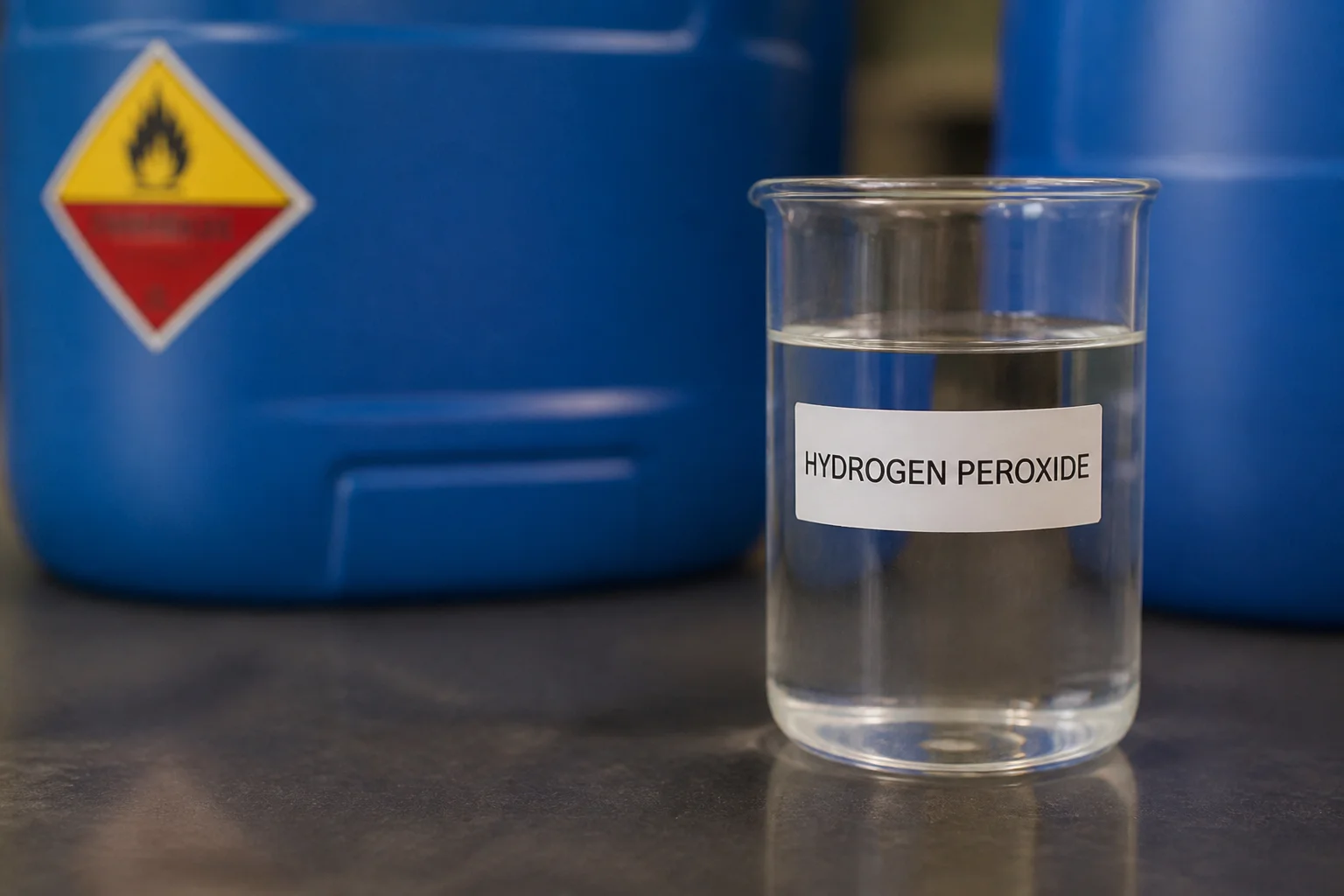
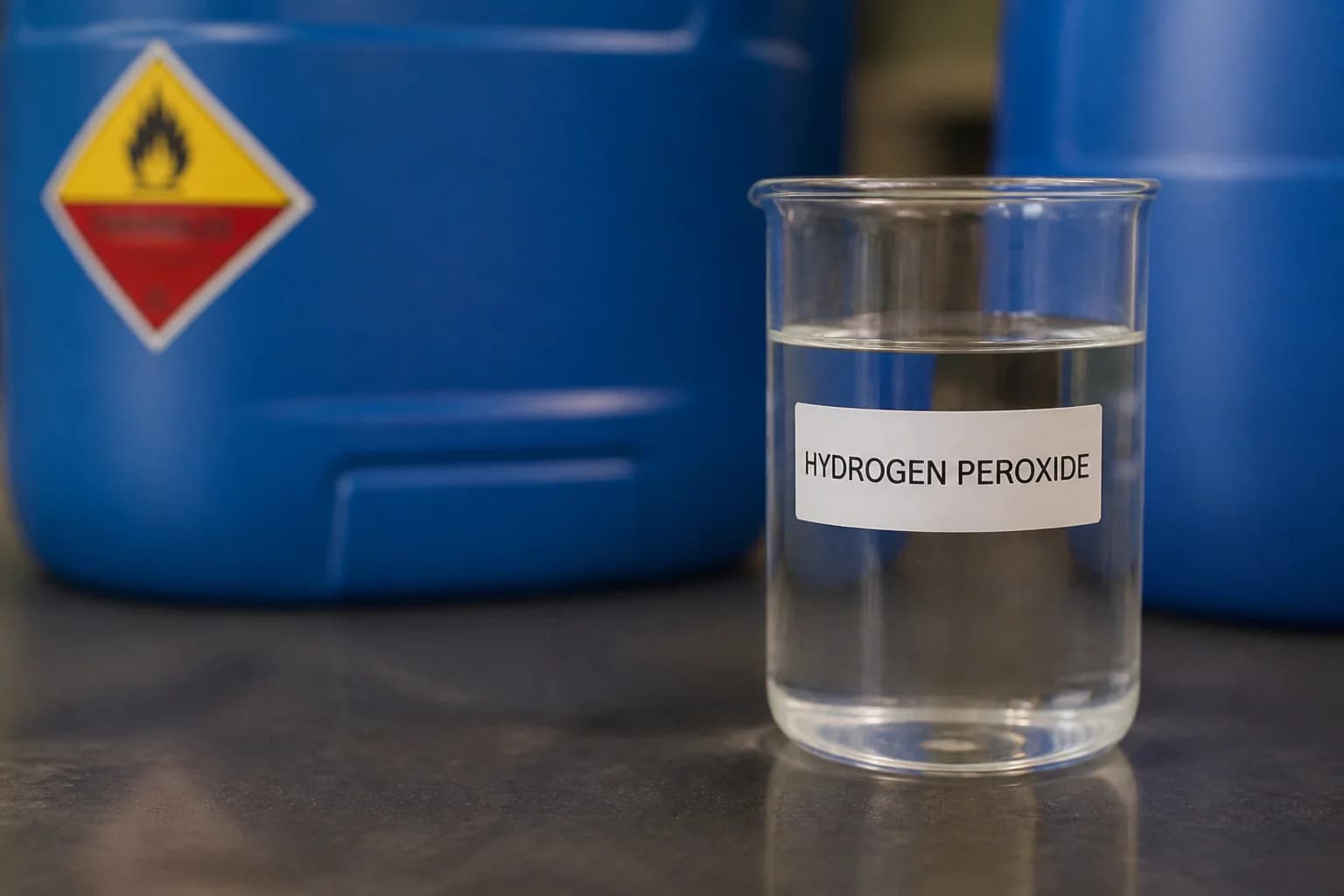
Hydrogen peroxide kills bacteria through oxidation, similar to peracetic acid. At concentrations of 0.5–3%, it’s effective against most common food pathogens. The compound breaks down into water and oxygen, leaving no harmful residue.
Food facilities use hydrogen peroxide for aseptic packaging systems, fogging of storage rooms, and sanitizing processing equipment. It’s particularly good for porous surfaces where other sanitizers might get absorbed.
Stabilized Formulations
Pure hydrogen peroxide breaks down quickly when exposed to light, heat, or certain metals. Stabilized formulations include additives that slow this breakdown. These products last longer but may require rinsing depending on the stabilizers used.
Some facilities use hydrogen peroxide vapor systems. These generate a fog or vapor that reaches into cracks and crevices regular spray applications miss. It’s effective for whole-room sanitization during facility shutdowns.
H₂O₂ concentration guide:
- 0.5–1% solution: routine equipment sanitizing, 1-minute contact
- 3% solution: heavy-duty cleaning and sanitizing, 3–5 minute contact
- 7.5% solution: biofilm removal and deep cleaning, 10-minute contact
- Vapor systems: 35% concentrate vaporized for room treatment
- Aseptic packaging: 30–35% solution with heat activation kills spores
| Application | First Choice | Alternative | Not Recommended |
| Stainless steel surfaces | Peracetic acid | Quats, H₂O₂ | High-conc. chlorine |
| Plastic conveyor belts | Chlorine dioxide | PAA, H₂O₂ | Quats (absorption) |
| Rubber gaskets/seals | H₂O₂ | Mild chlorine | Quats, strong PAA |
| Cold storage rooms | PAA fogging | H₂O₂ vapor | Liquid chlorine |
| Fresh produce washing | Chlorine dioxide | PAA 40–80 ppm | Quats |
| CIP systems | PAA or chlorine | H₂O₂ | Quats (residue) |
Wrapping Up
Picking the right food disinfectant comes down to matching chemistry to your specific needs. Peracetic acid works great in cold areas and doesn’t need rinsing, making it perfect for refrigerated processing lines. Quats are stable and gentle on equipment but need clean surfaces to work. Chlorine is cheap and effective but requires more careful handling and rinsing. Hydrogen peroxide fits specialized applications where other chemicals cause problems.
Elchemy connects you with suppliers offering EPA-registered disinfectants, quaternary ammonium compounds, peracetic acid formulations, and hydrogen peroxide solutions in bulk quantities — complete with technical specifications, dilution guidelines, and regulatory documentation to support your HACCP plans and food safety programs.