

Introduction
Specifying the wrong resin is an expensive mistake a coating that yellows in the sun, a floor that fails under traffic, or a bond that cracks under stress. For coatings, adhesives, flooring, and composite buyers, the acrylic resin vs epoxy resin decision is one of the most common and consequential choices in formulation. The two are often discussed together, but they are fundamentally different chemistries built for different jobs.
In short: epoxy delivers maximum toughness, adhesion, and chemical resistance, while acrylic delivers superior UV stability, colour retention, and fast, easy application. This epoxy resin vs acrylic resin comparison breaks down the differences in chemistry, performance, cost, and application so you can choose with confidence.
At a Glance
- Acrylic resin is usually a thermoplastic (one-part, dries by evaporation or cures by UV); epoxy resin is a thermoset (two-part, resin + hardener, cures irreversibly).
- Epoxy wins on adhesion, mechanical strength, abrasion and chemical resistance, and heat tolerance (often rated ~150–200°C).
- Acrylic wins on UV stability, gloss and colour retention (non-yellowing), fast drying, flexibility, and easy (often water-based) cleanup.
- Cost: water-based acrylics are generally cheaper; 100%-solids epoxies cost more but can lower total cost of ownership in heavy-duty use.
- A common best-of-both approach: an epoxy primer for adhesion, topped with an acrylic or polyurethane finish for UV resistance.
What you’ll learn: how acrylic and epoxy resins differ in chemistry and performance, the benefits of each, where each is used, and a practical guide to choosing the right resin for your application.
The Core Difference: Thermoplastic vs Thermoset
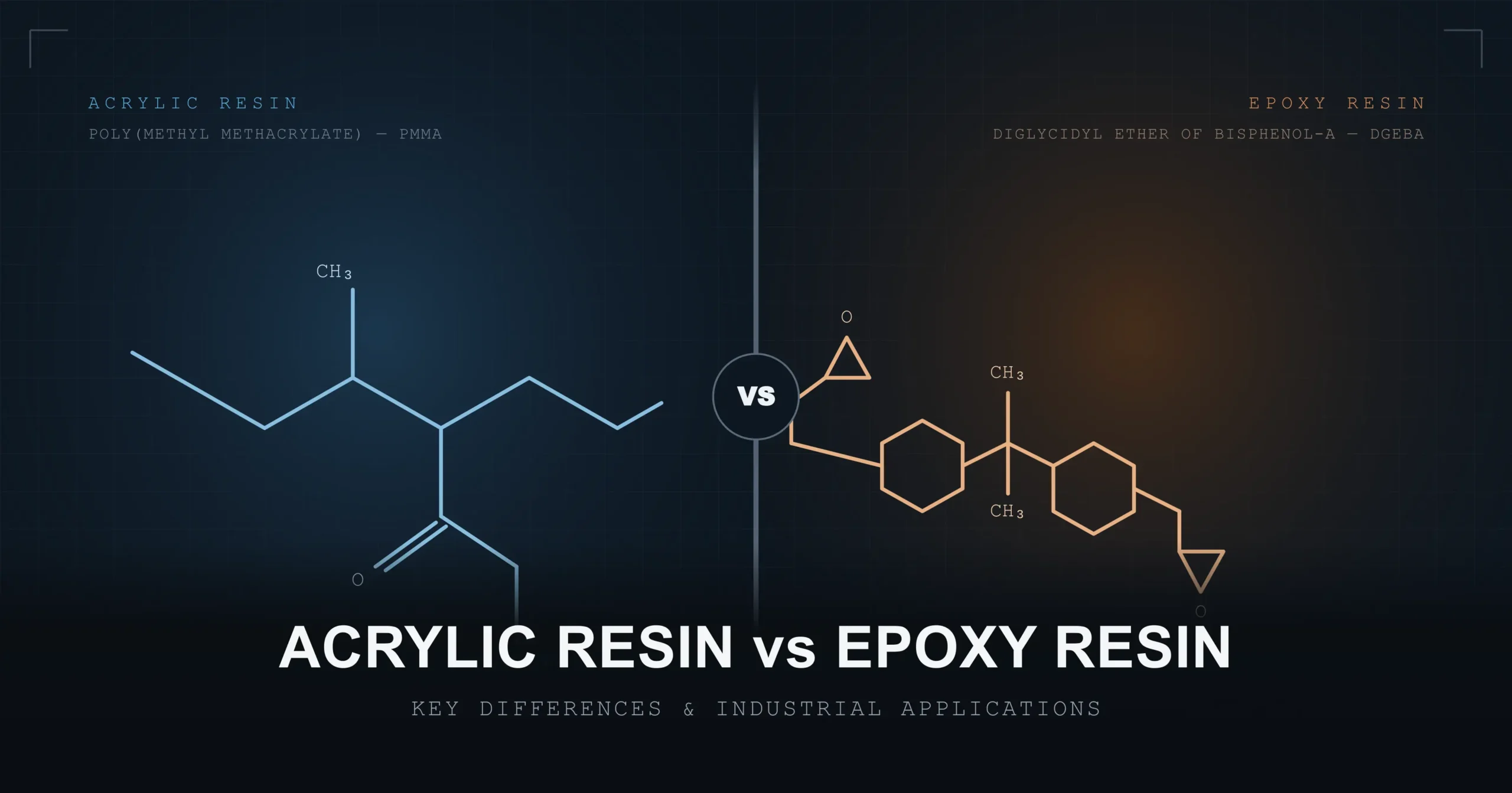
The defining distinction is how each resin cures. Acrylic resin is typically a thermoplastic: it forms a film as water or solvent evaporates (or cures rapidly under UV), and many grades can be re-softened with heat. It is usually supplied ready to use as a one-part system. Epoxy resin is a thermoset: a two-part system of resin and a hardener (such as a polyamine) that react together to form a rigid, three-dimensional crosslinked network. Once cured, epoxy cannot be re-melted or reshaped which is exactly what gives it its strength and chemical resistance. For more on acrylic chemistry, see acrylic resins explained.
Acrylic Resin vs Epoxy Resin: Side-by-Side Comparison
| Property | Acrylic Resin | Epoxy Resin |
| Cure type | Thermoplastic; 1-part, dries/UV-cures | Thermoset; 2-part, chemically cures |
| UV resistance | Excellent non-yellowing | Poor yellows/chalks outdoors |
| Adhesion | Good | Excellent (metal, wood, concrete) |
| Mechanical strength | Moderate | High impact & abrasion resistant |
| Chemical resistance | Moderate | Excellent |
| Heat resistance | Lower | High (~150–200°C grades) |
| Flexibility | More flexible / breathable | Rigid, hard |
| Cure speed / use | Fast, easy, often water-based cleanup | Slower; requires mixing |
| Typical cost | Lower (esp. water-based) | Higher |
| Best for | Topcoats, exterior, decorative, UV-exposed | Floors, primers, structural bonds, chemical exposure |
Benefits of Each Resin
Benefits of Acrylic Resin
• Outstanding UV stability and non-yellowing ideal for exterior and clear finishes.
• Excellent gloss and colour retention over years of weathering.
• Fast drying, easy application, and low-VOC water-based options with simple cleanup.
• Flexible and breathable, reducing cracking on moving or porous substrates.
Benefits of Epoxy Resin
• Exceptional adhesion to metal, concrete, wood, and composites.
• High mechanical strength, impact resistance, and abrasion resistance.
• Strong chemical and solvent resistance for harsh environments.
• Higher heat tolerance, suiting industrial and structural applications.
Industrial Applications: Which Resin for Which Job
Where Acrylic Resin Is Used
Acrylic excels wherever UV exposure, appearance, and fast turnaround matter: exterior architectural coatings and topcoats, automotive refinish, signage and PMMA glazing, decorative and wood finishes, and weather-exposed surfaces. Related comparison reading: polycrylic vs polyurethane for clear protective finishes.
Where Epoxy Resin Is Used
Epoxy excels wherever toughness and chemical resistance matter more than UV stability: industrial and warehouse flooring, high-traffic and chemical-exposure areas, structural and metal bonding adhesives, marine coatings, primers, and protective tank linings. Its strong adhesion also makes it the go-to primer beneath other topcoats.
The Hybrid Approach: Epoxy Primer + Acrylic Topcoat
In practice, many systems use both. An epoxy primer provides adhesion and chemical resistance to the substrate, while an acrylic (or polyurethane) topcoat adds the UV stability and colour retention epoxy lacks. This combination is common in industrial flooring, automotive, and metal protection capturing the strengths of each chemistry in a single build.
Cure, Application, and Handling Differences
The thermoplastic-versus-thermoset divide has practical consequences on the shop floor. Acrylic resins, especially one-part water-based grades, are simpler to apply: there is no mixing ratio to get wrong, pot life is not a constraint, drying is fast, and cleanup is often just soap and water. This makes acrylics well suited to high-throughput production and field application where speed and simplicity matter.
Epoxy systems demand more discipline. The resin and hardener must be mixed in the correct ratio, the mixed material has a limited pot life before it begins to cure, and full chemical and mechanical properties develop only after a longer cure sometimes days for maximum performance. That extra effort is the price of epoxy’s superior toughness and chemical resistance. On handling, water-based acrylics generally present lower VOC and odour concerns, while epoxies require attention to skin sensitisation from amine hardeners; both should be used with appropriate ventilation and PPE per their safety data sheets.
Cost and Total Cost of Ownership
On a per-litre or per-kilogram basis, water-based acrylic resins are typically less expensive than 100%-solids epoxy systems, and their faster application can further reduce labour cost. However, the cheapest material is not always the lowest-cost solution. In heavy-duty environments industrial floors, chemical exposure, high traffic epoxy’s durability can extend service life and reduce repair and recoat frequency, lowering total cost of ownership over time.
The smart approach is to price the whole service life, not just the drum. Where UV exposure would degrade epoxy, specifying acrylic (or an epoxy-primer/acrylic-topcoat hybrid) avoids premature failure and costly rework. For pricing context on acrylic systems, see our acrylic resin price guide.
Which Resin Is Better: Acrylic or Epoxy?
Neither resin is universally better the right choice depends on the application. Choose epoxy resin when you need maximum adhesion, mechanical strength, chemical resistance, and heat tolerance, such as for industrial floors, structural bonding, primers, and chemical-exposure environments. Choose acrylic resin when you need UV stability, gloss and colour retention, fast drying, and easy application, such as for exterior coatings, topcoats, decorative finishes, and signage. For demanding builds, an epoxy primer topped with an acrylic finish combines the strengths of both.
How to Choose Between Acrylic and Epoxy Resin
1. Will it face UV / sunlight? Yes → acrylic (epoxy yellows and chalks outdoors).
2. Does it need maximum chemical or abrasion resistance? Yes → epoxy.
3. Is strong structural adhesion the priority? Yes → epoxy.
4. Is fast turnaround, low VOC, or easy cleanup important? Yes → water-based acrylic.
5. Need both durability and UV stability? Use an epoxy primer with an acrylic or polyurethane topcoat.
Environmental and Regulatory Considerations
Regulation increasingly shapes the resin choice as much as performance does. Tightening VOC limits in North America and Europe favour water-based acrylic systems, which offer low-VOC compliance and simpler workplace handling a meaningful advantage in architectural and interior applications subject to indoor-air-quality standards. Solvent-based acrylics and conventional epoxies can carry higher VOC and handling burdens that add compliance cost.
Both chemistries are also moving toward lower-carbon options: bio-based acrylic monomers and recycled PMMA on the acrylic side, and bio-based and waterborne epoxy systems on the epoxy side. For brands with sustainability commitments, confirming a supplier’s low-VOC, bio-based, and documentation credentials (COA, TDS, SDS, and compliance data) is now a standard part of resin selection. See Elchemy’s sustainability and compliance approach.
Not Sure Which Resin Your Application Needs?
Tell Elchemy your substrate, environment, and performance targets we’ll help you specify acrylic, epoxy, or a hybrid system, and source a verified grade with a sample before bulk.
Conclusion
Acrylic and epoxy resins are not competitors so much as specialists. Epoxy is the choice for toughness, adhesion, and chemical resistance; acrylic is the choice for UV stability, colour retention, and fast, clean application. Match the resin to the dominant demand of your application and remember that combining an epoxy primer with an acrylic topcoat often delivers the best of both. Learn more in our acrylic resins guide and acrylic resin price guide, or contact Elchemy for sourcing help.
Frequently Asked Questions
What is the difference between acrylic resin and epoxy resin?
Acrylic resin is usually a one-part thermoplastic that dries by evaporation or UV cure and offers excellent UV stability, while epoxy resin is a two-part thermoset (resin plus hardener) that cures into a rigid, chemically resistant network. Epoxy is tougher and more chemical-resistant; acrylic is more UV-stable and easier to apply.
Which resin is better for coatings, acrylic or epoxy?
It depends on exposure. For exterior or UV-exposed coatings, acrylic is better because it resists yellowing and retains gloss and colour. For industrial floors, chemical-exposure areas, and primers, epoxy is better due to its adhesion and chemical resistance. Many systems use an epoxy primer with an acrylic topcoat.
Is epoxy or acrylic more durable?
Epoxy is generally more durable against mechanical wear, impact, abrasion, and chemicals, and tolerates higher temperatures. Acrylic is more durable against UV and weathering, keeping its appearance outdoors far longer than epoxy, which tends to yellow and chalk in sunlight.
Can you apply acrylic over epoxy?
Yes, applying an acrylic (or polyurethane) topcoat over an epoxy primer is a common and effective approach. The epoxy provides adhesion and chemical resistance to the substrate, while the acrylic adds UV stability and colour retention that epoxy alone lacks. Follow the manufacturer’s recoat and surface-prep guidance.
Which is cheaper, acrylic or epoxy resin?
Water-based acrylic resins are generally cheaper than 100%-solids epoxy systems. However, epoxy’s greater durability can lower total cost of ownership in heavy-duty applications by extending service life, so the cheapest option per litre is not always the lowest-cost choice over time.
Comparing resins for a specific build? Talk to an Elchemy sourcing expert.