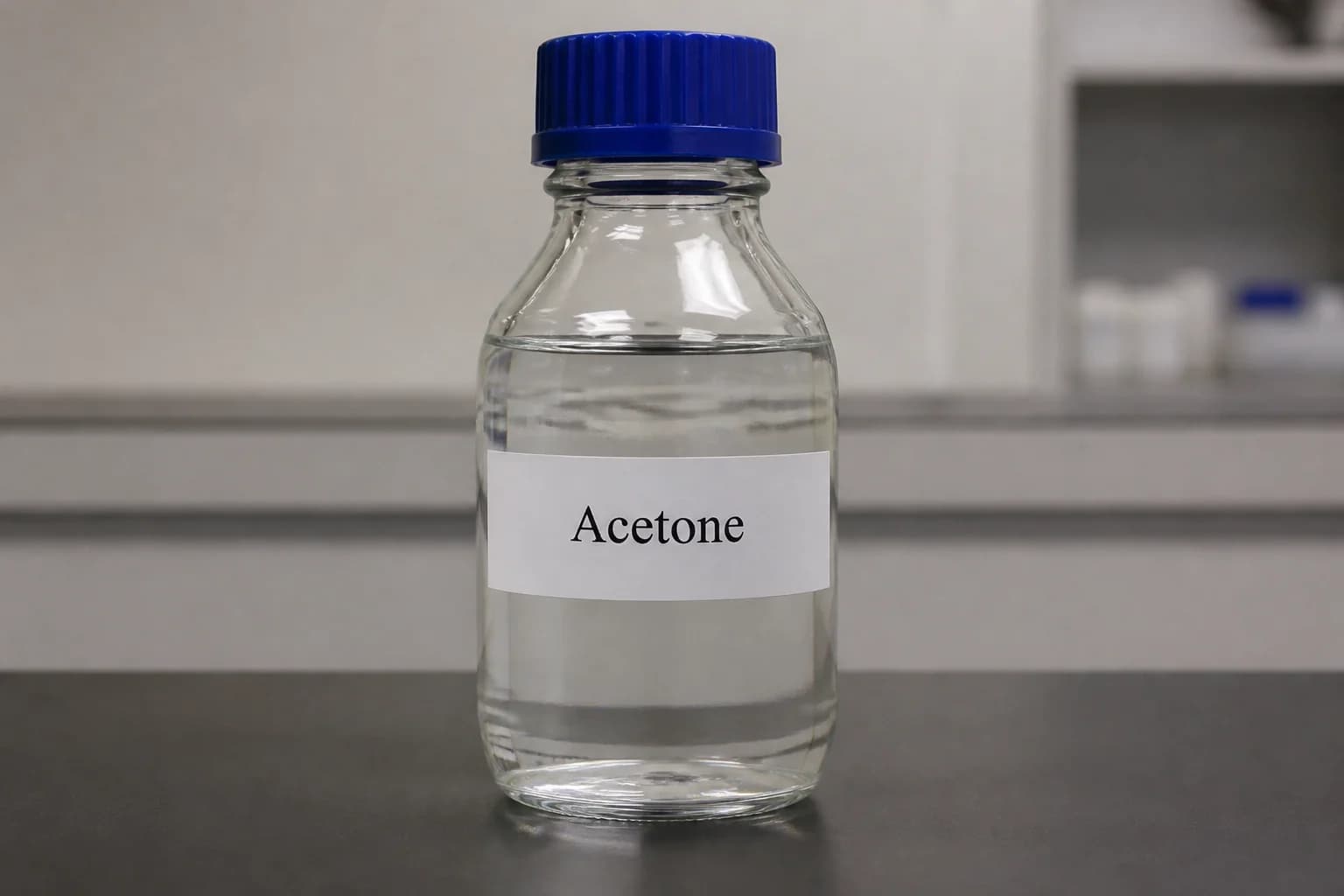
Acetone
ELRASATM – Ace
Get Pricing For This Product
Skip the quote. Sign up now and see pricing instantly
Speed Up Your Sample Testing Process
Express Delivery in 24–48 Hours
Acetone is a clear, colourless, highly volatile solvent with a characteristic sweet odour the simplest and most widely used ketone. It functions as a fast solvent, cleaning agent, chemical…
CAS Number
67-64-1
HS Code
29.14.11.00
INCI Name
Acetone
Molecular Formula
C₃H₆O
Acetone
ELRASATM – Ace
Acetone is a clear, colourless, highly volatile solvent with a characteristic sweet odour the simplest and most widely used ketone. It functions as a fast solvent, cleaning agent, chemical intermediate, thinner across coatings & adhesives, pharmaceuticals, plastics (PMMA, BPA),…
CAS Number
67-64-1
INCI Name
Acetone
HS Code
29.14.11.00
Molecular Formula
C₃H₆O
Get Pricing For This Product
Skip the quote. Sign up now and see pricing instantly
Speed Up Your Sample Testing Process
We deliver domestic samples within 24 - 48 hours, helping you evaluate product without delays.
Product Specification
Physical Properties
| Property | Specification |
|---|---|
| Appearance | Clear colorless liquid |
| Odor | Fruity odor |
| Molecular Weight (G/Mol) | 58.08 |
| Density Or Specific Gravity | 0.791 at 68 °F |
| Viscosity | 0.32 cP at 20 °C; 0.27 cP at 40 °C |
| Refractive Index | 1.3588 at 20 °C/D |
Thermal Properties
| Property | Specification |
|---|---|
| Melting Point | -137 °F |
| Boiling Point | 133 °F at 760 mmHg |
| Flash Point | 0 °F |
| Autoignition Temperature | 869 °F |
Processing Methods & Reference Formulations
A. Skin Cleanser
Acetone is volatile and flammable, so incorporate it after cooling the batch to avoid evaporation losses and safety hazards. Since acetone can strip natural oils, balance it with humectants (like glycerin) or emollients (like panthenol or aloe vera) to reduce skin dryness and irritation.
| Key Ingredients | Indicative Dosage (% w/w) |
|---|---|
| Ethanol | 64–70% |
| Acetone | 5–6% |
| Alkyl dimethyl benzyl ammonium chloride | 0.06–0.10% |
| Glycerin | 2–3% |
| Water / balance | ~28–29% |
B. Nail polish remover
Acetone should be added in the final mixing stage at room temperature, in a closed system, to minimize evaporation and flammability risks. To counteract acetone’s drying effect on nails and skin, incorporate emollients or humectants like glycerin, panthenol, castor oil, or aloe vera extract.
| Key Ingredients | Indicative Dosage (% w/w) |
|---|---|
| Acetone | 36–60% |
| Ethyl Acetate | 10–35% |
| Ethanol | 5–20% |
| Water | 5–20% |
| Glycerin | 3–15% |
C. Fragrance Spray
Due to its volatility and flammability, acetone should be added after cooling the base to room temperature and mixed under closed conditions to minimize evaporation loss. Test for solubility and stability of fragrance oils in acetone, as it may alter scent structure or cause hazing with some essential oils or fixatives.
| Key Ingredients | Indicative Dosage (% w/w) |
|---|---|
| Deionized Water | 71% |
| Fragrance Blend | 1.5% |
| Acetone | 5% |
| Acetonitrile | 12% |
| Propylene Glycol n-Propyl Ether | 10% |
D. Paint or Varnish Remover
Combine acetone with slower-evaporating solvents (e.g., methylene chloride, NMP, or alcohols) to balance evaporation rate, extend working time, and improve stripping efficiency. Incorporate acetone at room temperature and under ventilation to manage its high volatility and flammability. Mix in a closed system if possible.
| Key Ingredients | Indicative Dosage (% w/w) |
|---|---|
| Acetone | 30% |
| Methylene Chloride | 50% |
| Ethanolamine | 5% |
| Cellulose Derivative (thickener) | 2% |
| Water | 13% |
Dosing Guidelines
A. Dosing by Application
| Products | Typical dosage % |
|---|---|
| Nail Polish Removers | 30–60% |
| Textile Industry | 5–20% |
About Acetone
Acetone (propanone) is the simplest ketone and one of the most important industrial solvents, a fast-evaporating, water-miscible liquid that dissolves an exceptionally wide range of resins, plastics, oils and organics. It is used as a solvent and cleaner in coatings, adhesives and cosmetics (nail-polish remover), a chemical intermediate for methyl methacrylate (PMMA) and bisphenol-A, and a process and cleaning solvent in pharmaceuticals and electronics. Its combination of powerful solvency, full water and organic miscibility, very fast evaporation, low toxicity relative to many solvents, and low cost makes acetone a default workhorse solvent. It is supplied as technical, pharmaceutical (USP) and electronic grades, all at 99.5%+ purity. Industrial buyers sourcing Acetone in bulk also track acetone pricing closely, since it feeds directly into their downstream costs which is why working with an established acetone supplier and distributor like Elchemy matters.
- High Volatility: Rapid evaporation for quick drying processes.
- Clear and Colorless: Pure appearance with a sharp, distinctive odor.
- Fully Miscible: Mixes well with water, alcohol, and most organic solvents.
- Stable Yet Reactive: Reliable stability with excellent solvency capabilities.
- High Purity Production: Manufactured using the efficient cumene process.
About Acetone
Acetone (propanone) is the simplest ketone and one of the most important industrial solvents, a fast-evaporating, water-miscible liquid that dissolves an exceptionally wide range of resins, plastics, oils and organics. It is used as a solvent and cleaner in coatings, adhesives and cosmetics (nail-polish remover), a chemical intermediate for methyl methacrylate (PMMA) and bisphenol-A, and a process and cleaning solvent in pharmaceuticals and electronics. Its combination of powerful solvency, full water and organic miscibility, very fast evaporation, low toxicity relative to many solvents, and low cost makes acetone a default workhorse solvent. It is supplied as technical, pharmaceutical (USP) and electronic grades, all at 99.5%+ purity. Industrial buyers sourcing Acetone in bulk also track acetone pricing closely, since it feeds directly into their downstream costs which is why working with an established acetone supplier and distributor like Elchemy matters.
- High Volatility: Rapid evaporation for quick drying processes.
- Clear and Colorless: Pure appearance with a sharp, distinctive odor.
- Fully Miscible: Mixes well with water, alcohol, and most organic solvents.
- Stable Yet Reactive: Reliable stability with excellent solvency capabilities.
- High Purity Production: Manufactured using the efficient cumene process.
Regulatory Compliance
| Region | Max Allowed Level | Notes | Certification Body |
|---|---|---|---|
| Australia | - | No explicit national restriction; follows international safety assessments. | - |
| China | - | Not listed as prohibited or restricted. | NMPA - National Medical Products Administration |
| India | - | Used in cosmetics, especially nail polish removers. No explicit national restriction found | - |
| Japan | - | No explicit national restriction; aligns with international safety standards. | MHLW – Ministry of Health, Labour and Welfare |
| Republic of Korea | - | No explicit national restriction. | MFDS - Ministry of Food and Drug Safety |
| United States | - | Acetone is permitted in cosmetics (e.g., nail polish remover). No FDA limit; considered safe as used | FDA |
| ASEAN | - | ASEAN Cosmetic Directive does not list acetone as prohibited or restricted. | - |
| European Union | - | Not listed as a restricted or prohibited substance. | SCCS (Scientific Committee on Consumer Safety) |
FAQs - Acetone
Related Products
Related Products
Streamline
Your Chemical
Procurement
Get fast responses from real experts